August 31, 2026
Products
Services
Industries
About
Resources
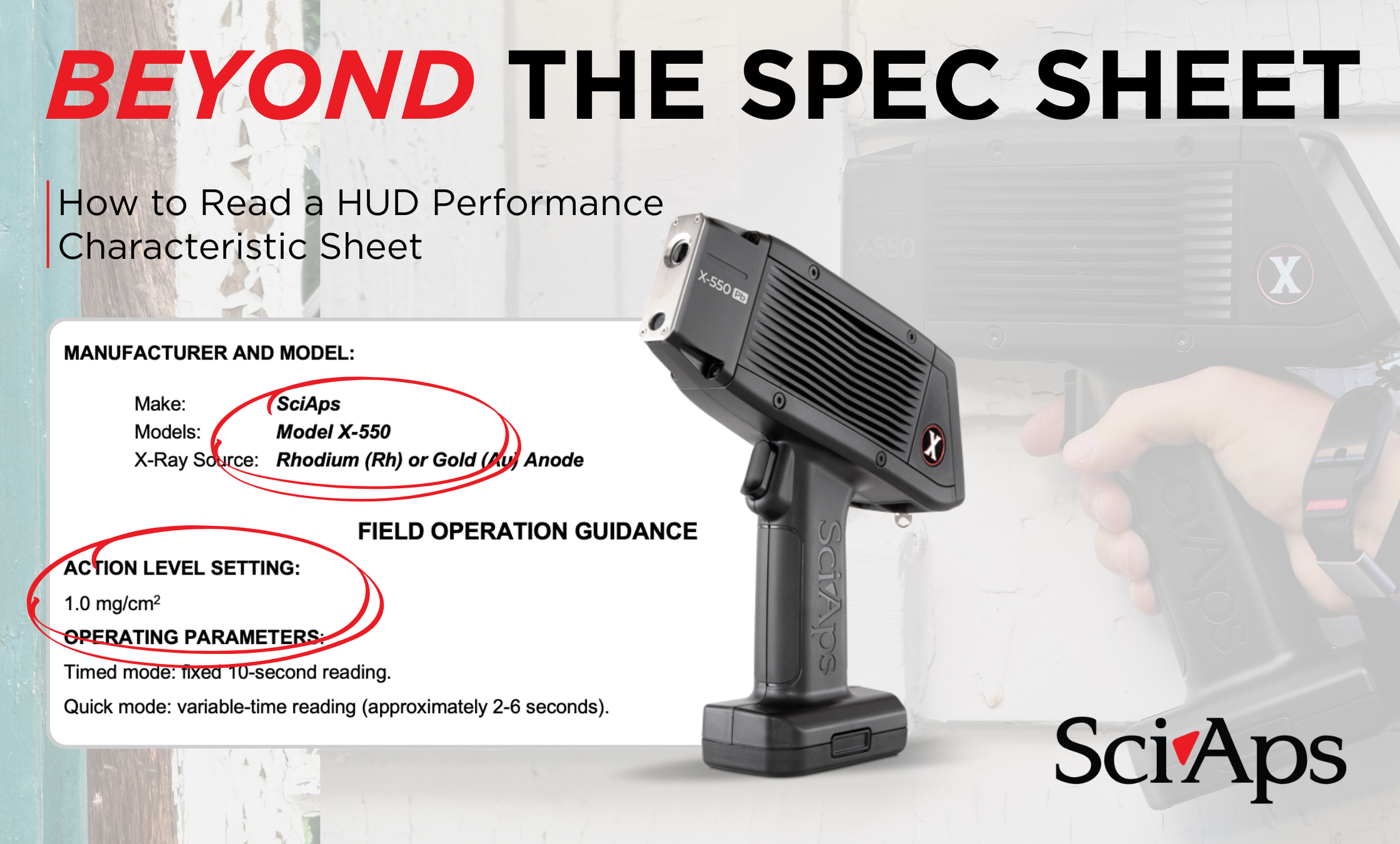
When evaluating a handheld XRF analyzer for residential lead paint inspections, a product specification sheet only tells part of the story.
One of the most important documents to understand is the HUD Performance Characteristic Sheet (PCS). It provides performance information that can help inspectors, risk assessors, environmental consultants, and other professionals understand how an XRF performs when analyzing painted building components.
For someone purchasing or using an XRF, the PCS can answer a much more important question than "What features does this analyzer have?"
It answers the question: Can I rely on its results to make the right field decision?
If an XRF analyzer were a student, its brochure would tell you what classes it took.
The Performance Characteristic Sheet tells you how it performed on the test.
Published by the U.S. Department of Housing and Urban Development (HUD), a Performance Characteristic Sheet (PCS) documents the results of independent performance testing conducted according to HUD-established protocols on actual painted building components (not laboratory samples) to evaluate how reliably an XRF analyzer classifies lead-based paint at specified regulatory action levels.
In simple terms, a PCS helps you understand how an analyzer performs when it has to make the decision that matters in the field: Is this painted surface above or below the applicable lead-based paint action level?
That's why knowing how to read a PCS is important when selecting an XRF.
A PCS contains several pieces of information that can have a direct impact on how an inspector uses an analyzer. Four areas deserve particular attention: classification performance, inconclusive results, action levels, and test time.
An XRF measurement ultimately needs to support a decision.
A result may classify a painted component as positive or negative relative to the applicable action level. The PCS helps demonstrate how well the analyzer makes those classifications during performance testing.
There are two important ways an analyzer can get that decision wrong:
False negative: The analyzer classifies paint as below the action level when it is actually above it. This can result in lead-based paint being missed and the associated hazard going unaddressed.
False positive: The analyzer classifies paint as above the action level when it is actually below it. This can lead to unnecessary follow-up, remediation, or other corrective action.
Neither outcome is desirable.
The goal isn't simply to obtain a numerical reading. The goal is to obtain a result that can be confidently used to make the appropriate decision.
An inconclusive result is different from an inaccurate result.
Instead of classifying the measurement as clearly positive or negative, the result falls into a range where the analyzer cannot make a definitive classification under the PCS criteria.
Think of it as the analyzer saying:
"I need more information."
Depending on the applicable inspection procedures, an inconclusive result may require additional XRF measurements, substrate consideration, or laboratory analysis to resolve.
For an inspector, that can mean:
This makes the size and location of an analyzer's inconclusive range an important factor when comparing XRFs.
An action level is the concentration at which a measurement is classified as positive for lead-based paint under the applicable requirements.
A PCS is associated with a specific action level, so it is important to understand which action level or levels an analyzer has demonstrated performance for.
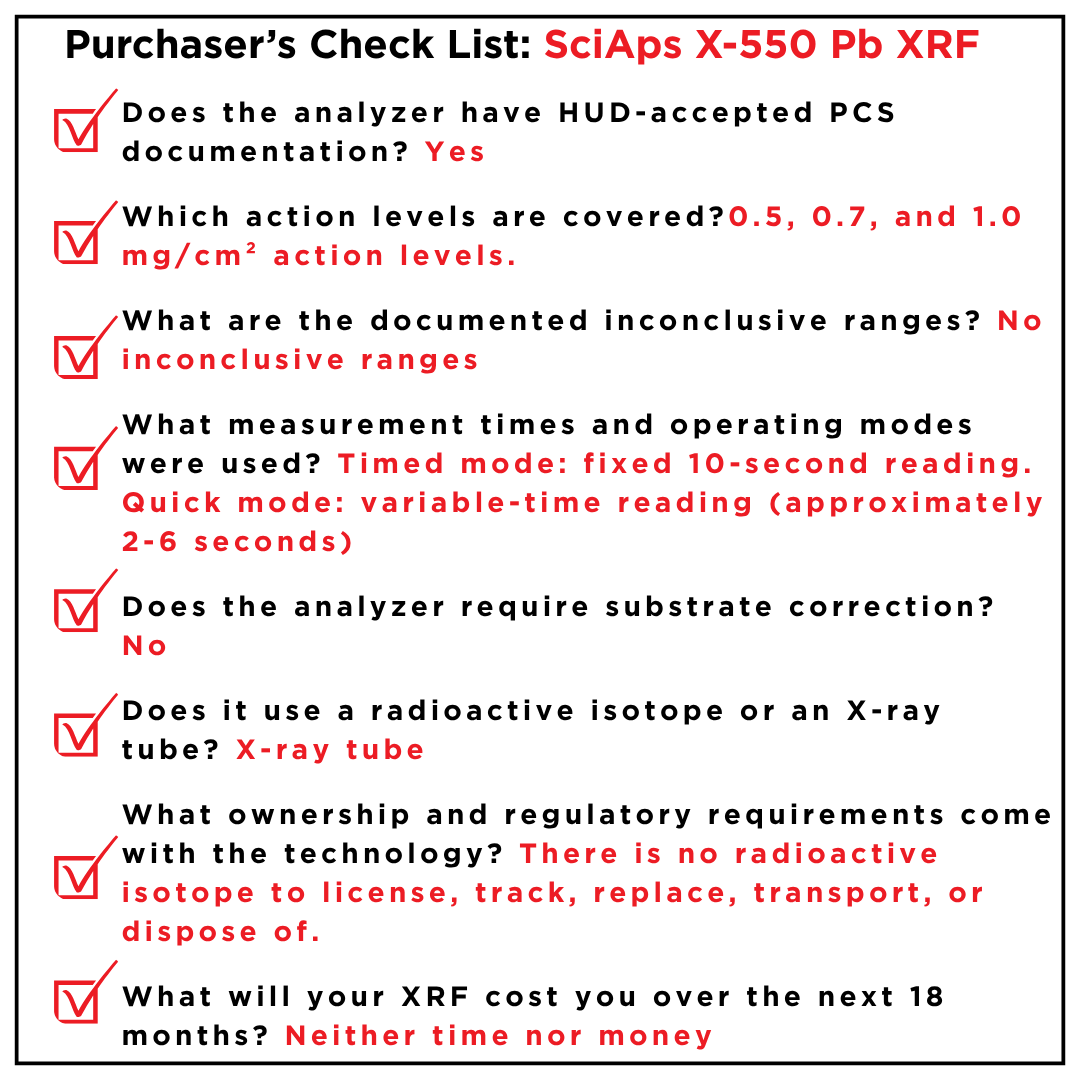
For example, the SciAps X-550 Pb has HUD-accepted PCS documentation for 0.5 (Rh and Au Anode), 0.7 (Tungsten Anode), and 1.0 (Tungsten Anode) mg/cm² action levels.
When comparing analyzers, don't simply ask whether an instrument has a PCS.
Ask: "At what action level was its performance demonstrated?"
The PCS also identifies the operating mode and measurement time used during performance testing.
A difference of a few seconds may not sound significant when you're looking at one measurement.
But an inspector may perform hundreds or even thousands of measurements over the course of a week.
For example, saving just 10 seconds on each of 500 measurements saves more than 80 minutes of measurement time.
That makes test time more than a specification. It can affect the efficiency of the entire inspection workflow.
Once you understand the basics, there are several additional details worth examining when comparing analyzers.
Paint is applied to something—a wood component, metal surface, plaster, drywall, or another substrate. The substrate can affect an XRF measurement.
A PCS can provide information about how the analyzer accounts for different substrates and whether substrate correction is required as part of the measurement process.
Don't compare test times without looking at how the analyzer was operated to achieve them.
A very short measurement time may not tell the whole story if it requires a particular operating mode or comes with other limitations.
Look at the measurement time, operating mode, and associated PCS performance together.
A PCS also provides information about the conditions and procedures used during performance testing.
When evaluating an analyzer, consider how calibration and quality-control procedures fit into the instrument's day-to-day workflow.
Once you've learned how to read a PCS, the next question is:
What does the analyzer's underlying technology mean for ownership and everyday use?
For years, radioactive isotope sources have been used in handheld XRF analyzers for lead paint analysis.
The SciAps X-550 Pb takes a different approach.
Instead of a radioactive isotope source, it uses an electronically generated X-ray tube and a silicon drift detector.
Most importantly, this isn't a case of choosing between a non-isotope instrument and demonstrated performance.
That combination—non-isotope technology plus documented HUD performance—is what makes the X-550 Pb different.
The difference between an X-ray tube and a radioactive isotope isn't simply a technical distinction. It can affect the ownership and operating experience of the analyzer.
An isotope-based analyzer contains a radioactive source that must be managed throughout the instrument's life.
Depending on the jurisdiction and applicable requirements, radioactive-source ownership can involve considerations such as:
The X-550 Pb uses an X-ray tube instead. There is no radioactive isotope source to manage, replace, or dispose of.
Radioactive isotopes decay naturally over time.
As an isotope source loses activity, the source's output decreases. This affects the measurement process and ultimately requires replacement of the source.
An X-ray tube generates X-rays electronically when the analyzer is operating. It does not rely on radioactive decay.
That means users don't have to plan around isotope half-life or eventual isotope replacement.
If you're comparing a new lead paint analyzer with an existing isotope-based XRF, don't compare brochures alone.
Compare the PCS. Then look at the technology behind the performance.
Before making a purchase, ask:
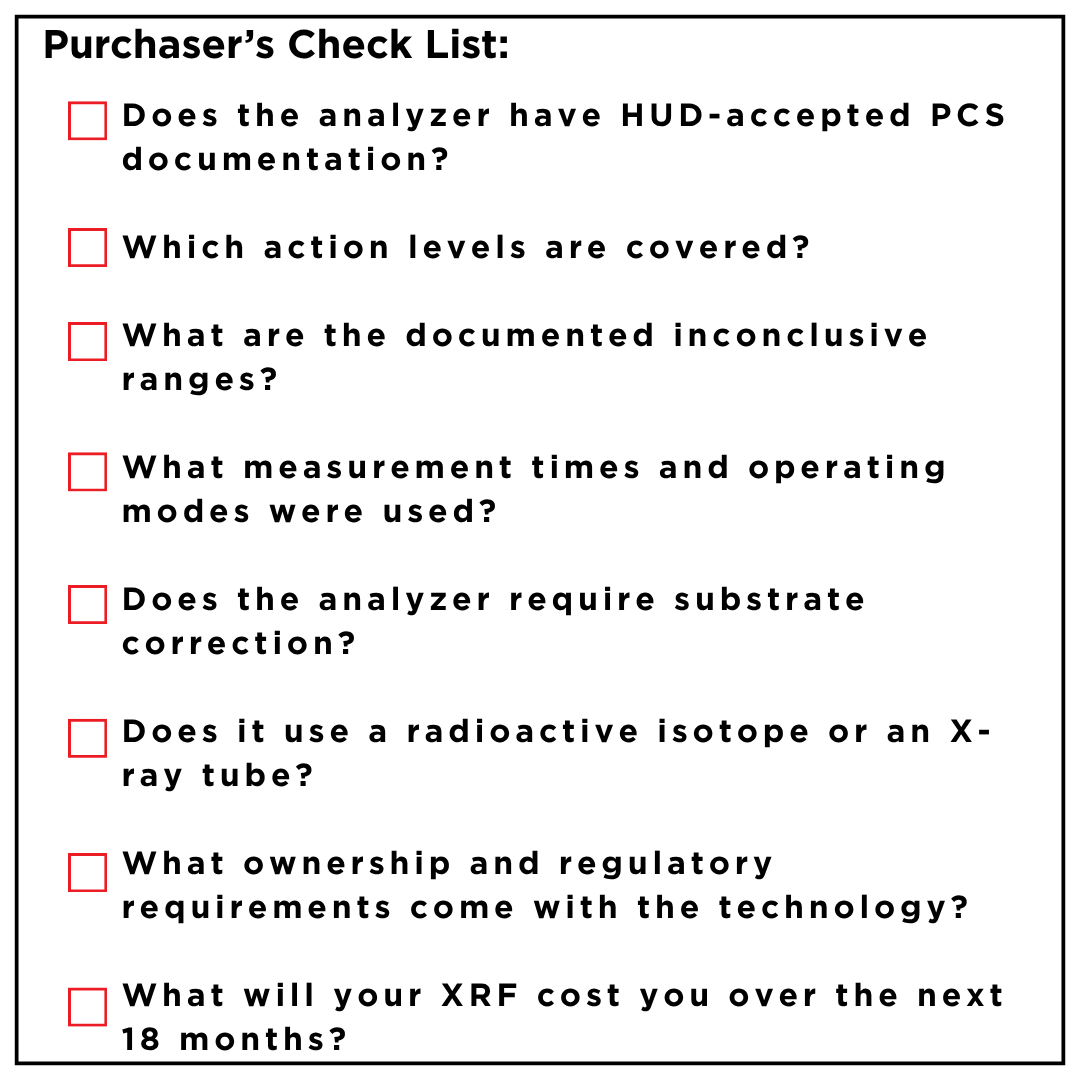
These questions can reveal meaningful differences between analyzers that may look similar on a specification sheet.
A Performance Characteristic Sheet is more than a regulatory document. It provides a window into how an XRF performed under defined testing conditions and gives users important information for evaluating an analyzer's ability to make reliable field classifications.
But the PCS is only part of the purchasing decision.
Look at the performance.
Look at the workflow.
And look at the technology behind the instrument.
The SciAps X-550 Pb combines HUD-accepted PCS performance at 0.5, 0.7, and 1.0 mg/cm² action levels with the advantages of electronically generated X-ray tube technology.