
July 27, 2026
Products
Services
Industries
About
Resources

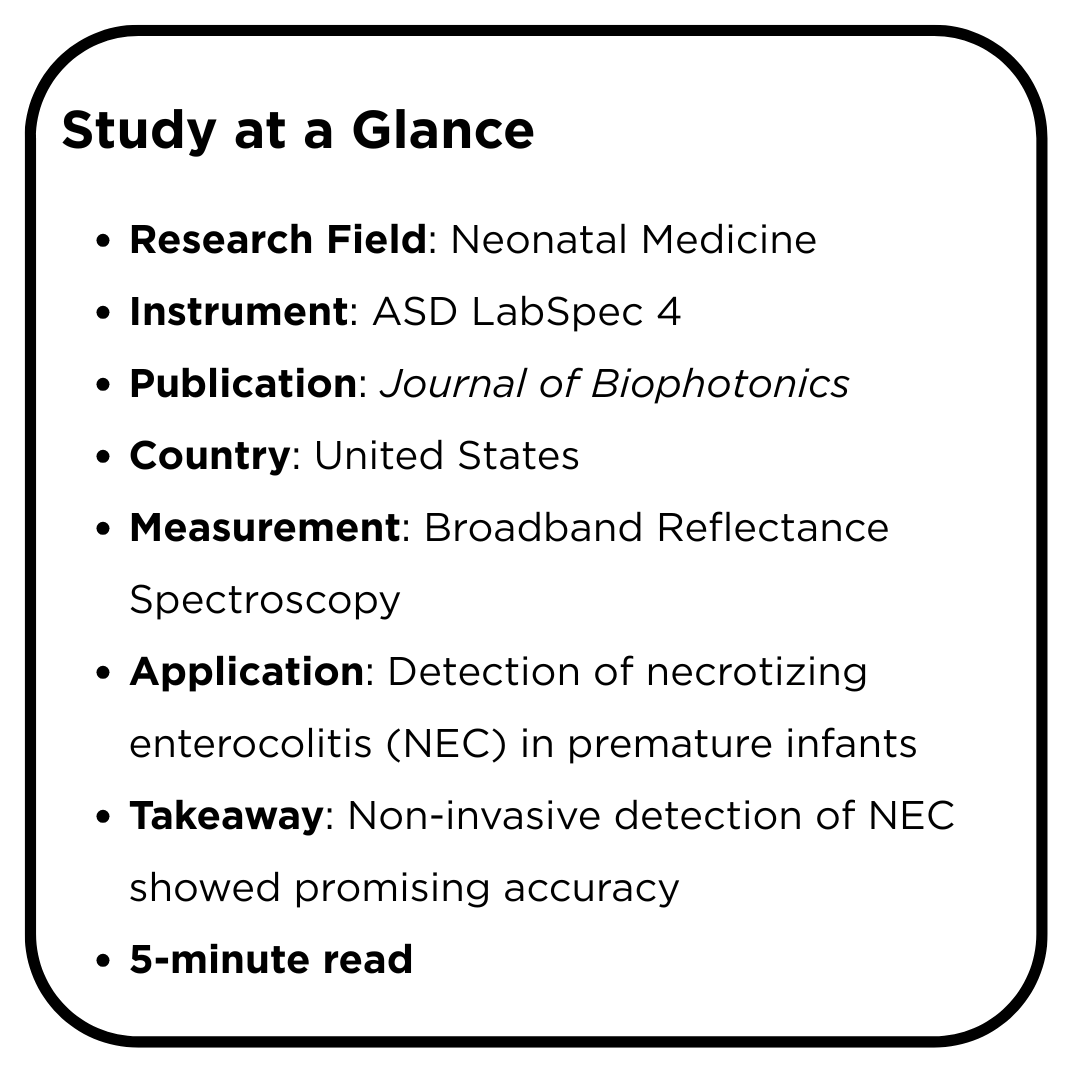
Researchers use ASD LabSpec 4 to detect the optical signatures of necrotizing enterocolitis in premature infants.
For decades, Star Trek's Dr. McCoy could diagnose patients with a simple handheld scan, no needles, no radiation, just instant insight. While we're not quite carrying tricorders in hospitals yet, researchers are taking meaningful steps in that direction. A recent study used ASD's LabSpec 4 broadband spectrometer to detect the spectral signatures of necrotizing enterocolitis (NEC), a life-threatening intestinal disease in premature infants, using nothing more than reflected light.
Paper: Necrotizing Enterocolitis Detection in Premature Infants Using Broadband Optical Spectroscopy (published in the Journal of Biophotonics, 2025)
Necrotizing enterocolitis (NEC) is one of the most serious gastrointestinal diseases affecting premature infants. It causes inflammation and tissue death in the intestines and can progress rapidly, with mortality rates approaching 50% in severe cases. One of the biggest clinical challenges is that there is currently no reliable, non-invasive method for detecting NEC early enough to improve outcomes. Diagnosis often depends on symptoms and radiographic findings that appear after the disease has already progressed.
Researchers from Northwestern University and Lurie Children's Hospital investigated whether Broadband Optical Spectroscopy (BOS) could detect early physiological changes associated with NEC.
The study included:
Instead of relying on conventional near-infrared monitoring that measuresonly a handful of wavelengths, the researchers analyzed an extremely broadspectral range spanning the visible and near-infrared regions.
The researchers collected every spectrum using an ASD LabSpec 4 spectrometer (now part of SciAps).
Specifically, the instrument provided:
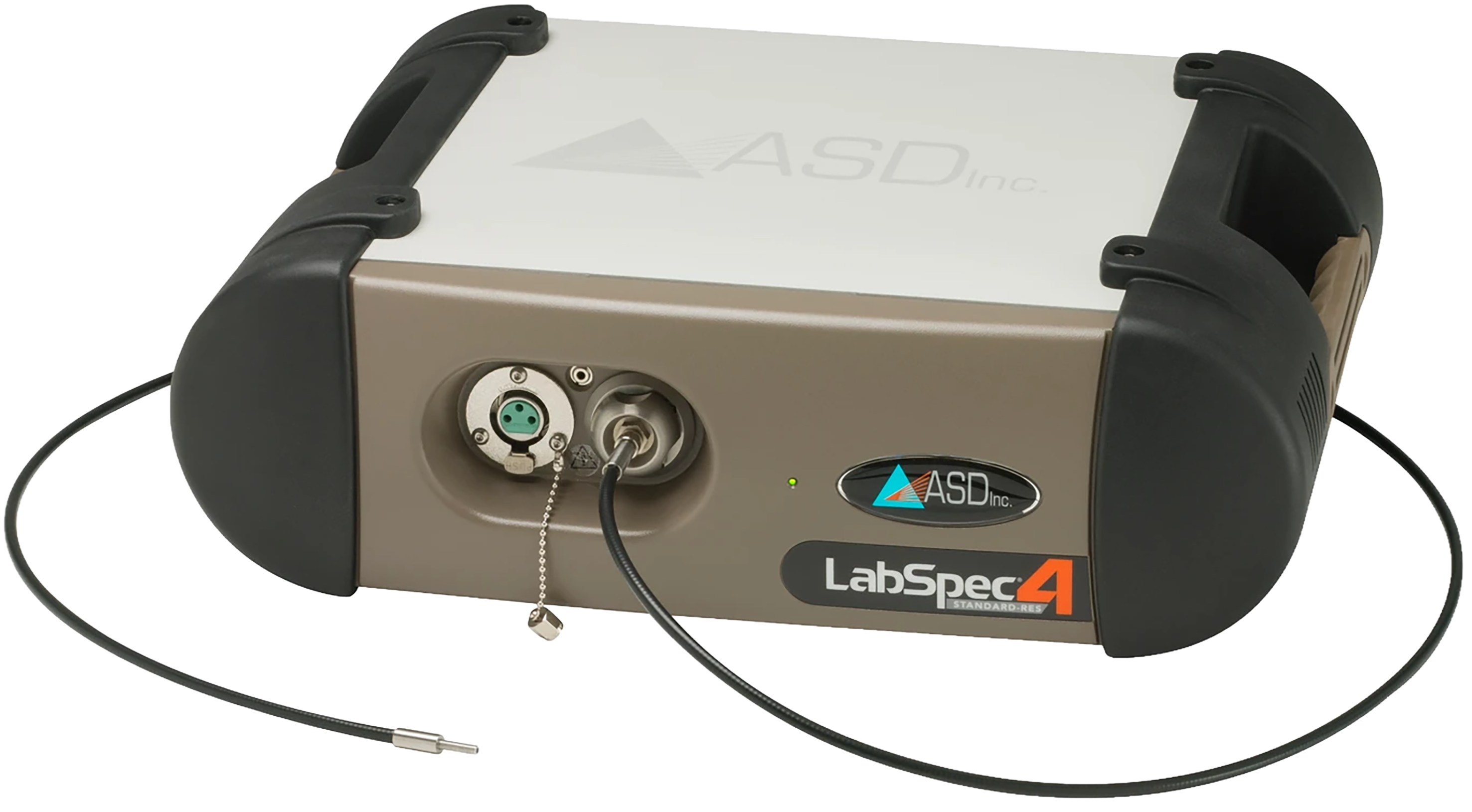
According to the paper, the LabSpec 4 provided 100–500 times greater spectral resolution than commercially available NIR oximeters used in neonatal medicine. That level of spectral detail allowed the researchers to detect subtle tissue differences that conventional monitoring systems cannot observe.
The researchers found that broadband optical spectroscopy contains enough information to distinguish NEC from healthy tissue with high accuracy.
Their optimized neural network achieved approximately:
An important contribution of the study was the development of a new feature-selection method called iterative Principal Component Analysis (iPCA). Rather than requiring the entire spectrum, the algorithm identified a small number of highly informative wavelengths that still maintained excellent diagnostic performance.
The authors conclude that a future medical device could potentially screen premature infants using as few as seven carefully selected wavelengths, making bedside implementation much more practical.
This study is a strong example of how ASD broadband spectroscopy is enabling discoveries beyond traditional spectroscopy applications. By providing laboratory-grade spectral data across the full 350–2500 nm range, the ASD LabSpec 4 helped researchers identify optical signatures of a devastating neonatal disease that could lead to faster, non-invasive diagnosis and improved outcomes for premature infants.
Flowerday, E., Daneshkhah, A., Su, Y., Backman, V. and Goldstein, S.D. (2025), Necrotizing Enterocolitis Detection inPremature Infants Using Broadband Optical Spectroscopy. J. Biophotonics, 18:e202400273.

Necrotizing enterocolitis (NEC) is a devastating disease affecting premature infants. Broadband optical spectroscopy (BOS) is a method of noninvasive optical data collection from intra-abdominal organs in premature infants, offering potential for disease detection. Herein, a novel machine learning approach, iterative principal component analysis (iPCA), is developed to select optimal wavelengths from BOS data collected in vivo from neonatal intensive care unit (NICU) patients for NEC classification. Neural network models were trained for classification, with a reduced-feature model distinguishing NEC with an accuracy of 88%, a sensitivity of 89%, and a specificity of 88%. While whole-spectrum models performed the best for accuracy and specificity, a reduced feature model excelled in sensitivity, with minimal cost to other metrics. This research supports the hypothesis that the analysis of human tissue via BOS may permit noninvasive disease detection. Furthermore, a medical device optimized with these models may potentially screen for NEC with as few as seven wavelengths.
deep learning, diagnosis, machine learning,neonatal diseases, spectroscopy
https://doi.org/10.1002/jbio.202400273
Journal of Biophotonics, a Wiley physics journal, focuses on the interdisciplinary field of biophotonics, publishing cutting-edge research on interactions between light and biological material.
We cover photonics research in areas such as life sciences, medicine and biomedicine, environmental science, nutrition, biology, physics, and chemistry, ranging from fundamental research to the latest clinical applications.


