
September 29, 2026
Products
Services
Industries
About
Resources
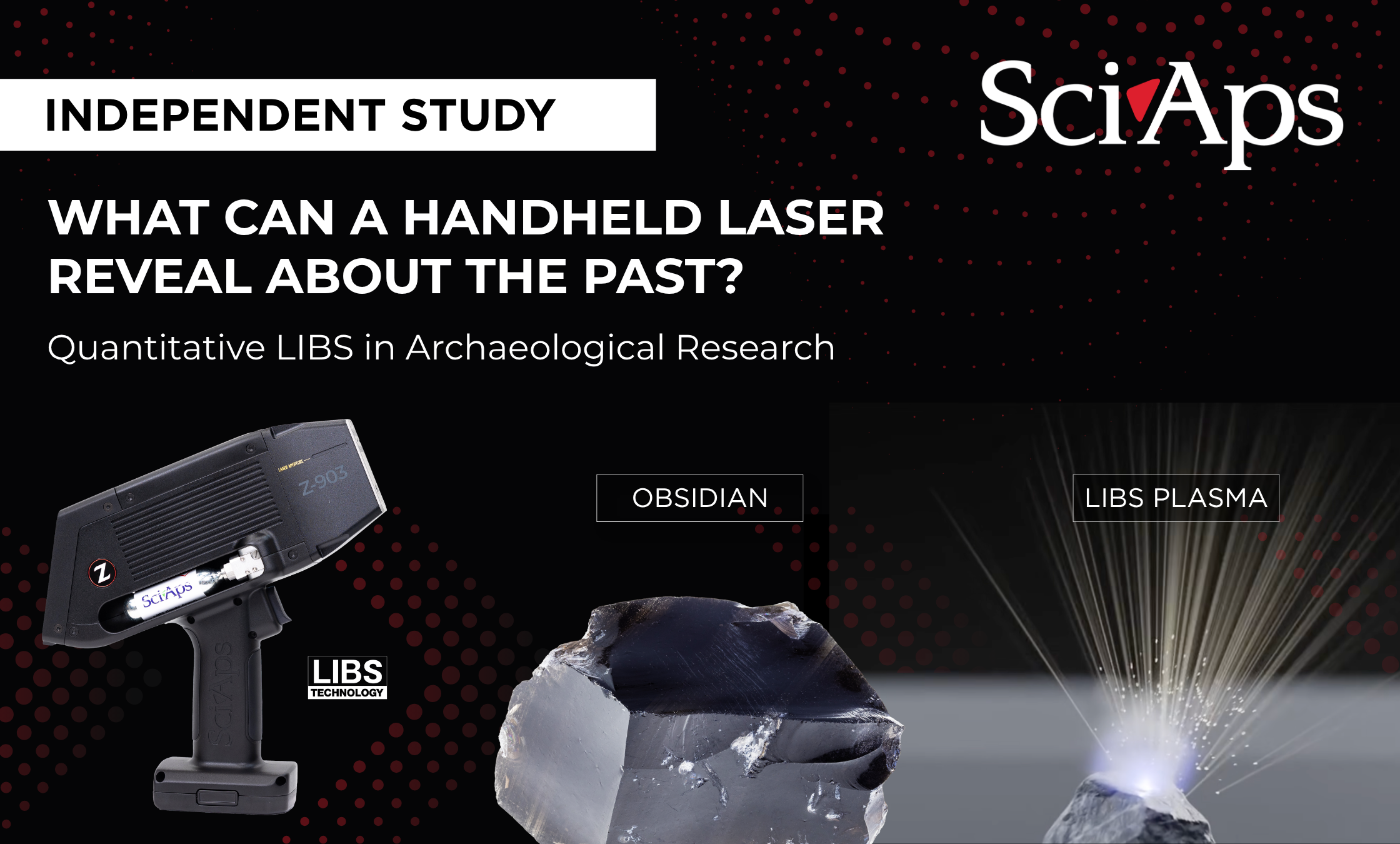
Researchers studying artifacts from the Archaeological Park of Tindari in Sicily used a SciAps Z-903 handheld LIBS analyzer to move beyond simply identifying elements. They developed a chemometrics-assisted calibration capable of quantitatively determining major, minor, and trace elements in silica-based materials.
Archaeological materials can hold clues about their origins, manufacturing methods, trade routes, and history—but obtaining that information can be challenging.
Traditional laboratory techniques can require specialized facilities, sample preparation, and transportation of artifacts. For culturally significant or fragile objects, minimizing sampling and handling is especially important. LIBS helps minimize destruction of ancient artifacts required for traditional laboratory techniques by testing a ~100 um area of the sample instead of requiring large amounts of the sample to dissolve in acid.
Handheld LIBS offers rapid, in situ elemental analysis, but quantitative measurements require more than simply detecting spectral peaks. Reliable concentration measurements depend on appropriate reference materials, calibration, spectral processing, and validation.
The researchers developed a chemometrics-assisted calibration using 17 silica-based standards, including eight certified reference materials and nine geological samples with independently established chemical compositions.
The standards were analyzed using handheld LIBS, and the resulting spectra were processed using:
The resulting models were evaluated using RMSE, bias, R², LOD, and LOQ.
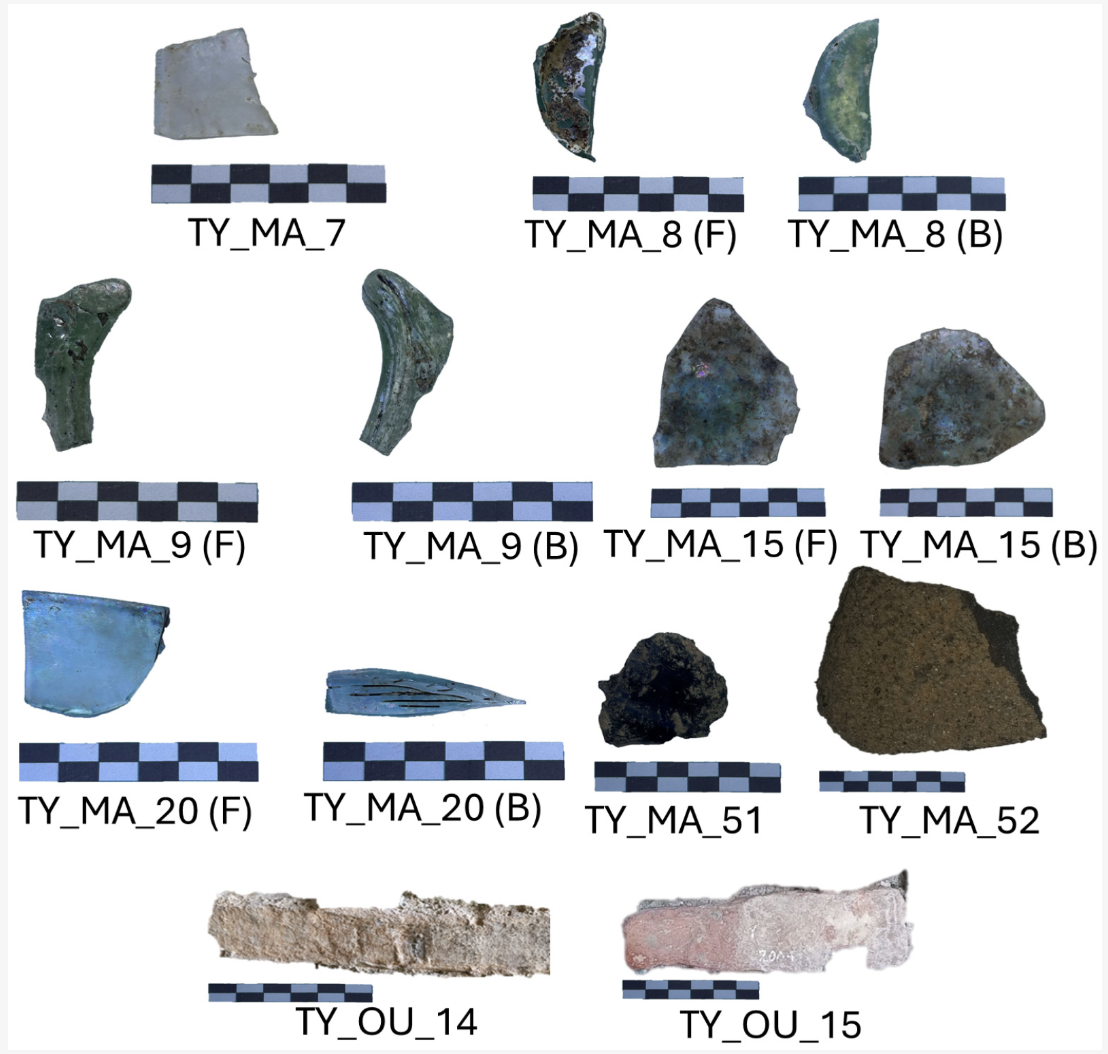
The researchers then applied the calibrated method to nine archaeological samples from Tindari, including bricks, glass fragments, volcanic rock, and obsidian.
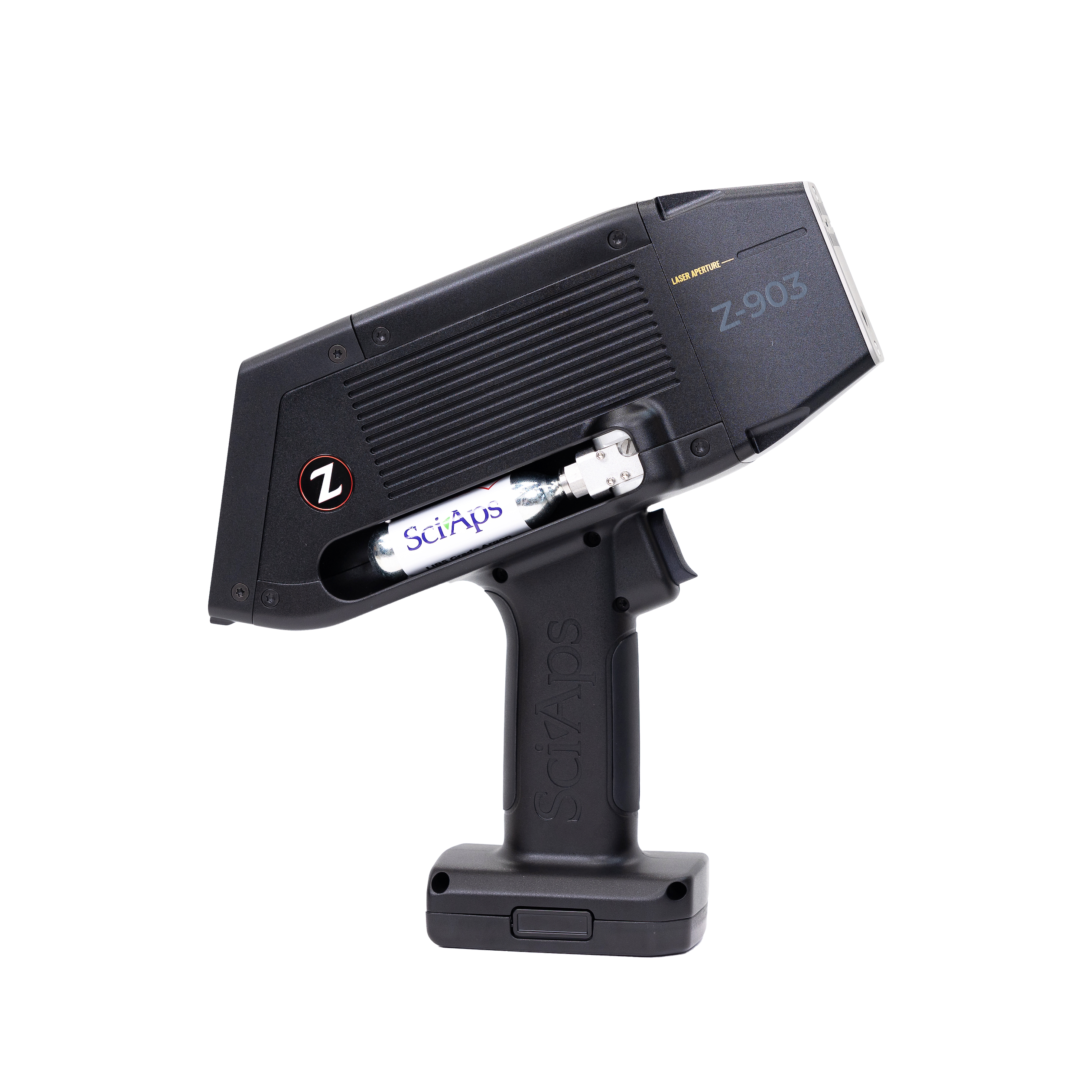
The research was performed using a SciAps Z-903 handheld LIBS analyzer, equipped with a 1064 nm Nd:YAG laser and a 180–950 nm spectral range.
The Z-903 provided the broadband spectral data used to construct the quantitative models. Rather than relying solely on individual emission lines, the researchers were able to apply multivariate chemometric methods to the spectral information collected by the handheld instrument.
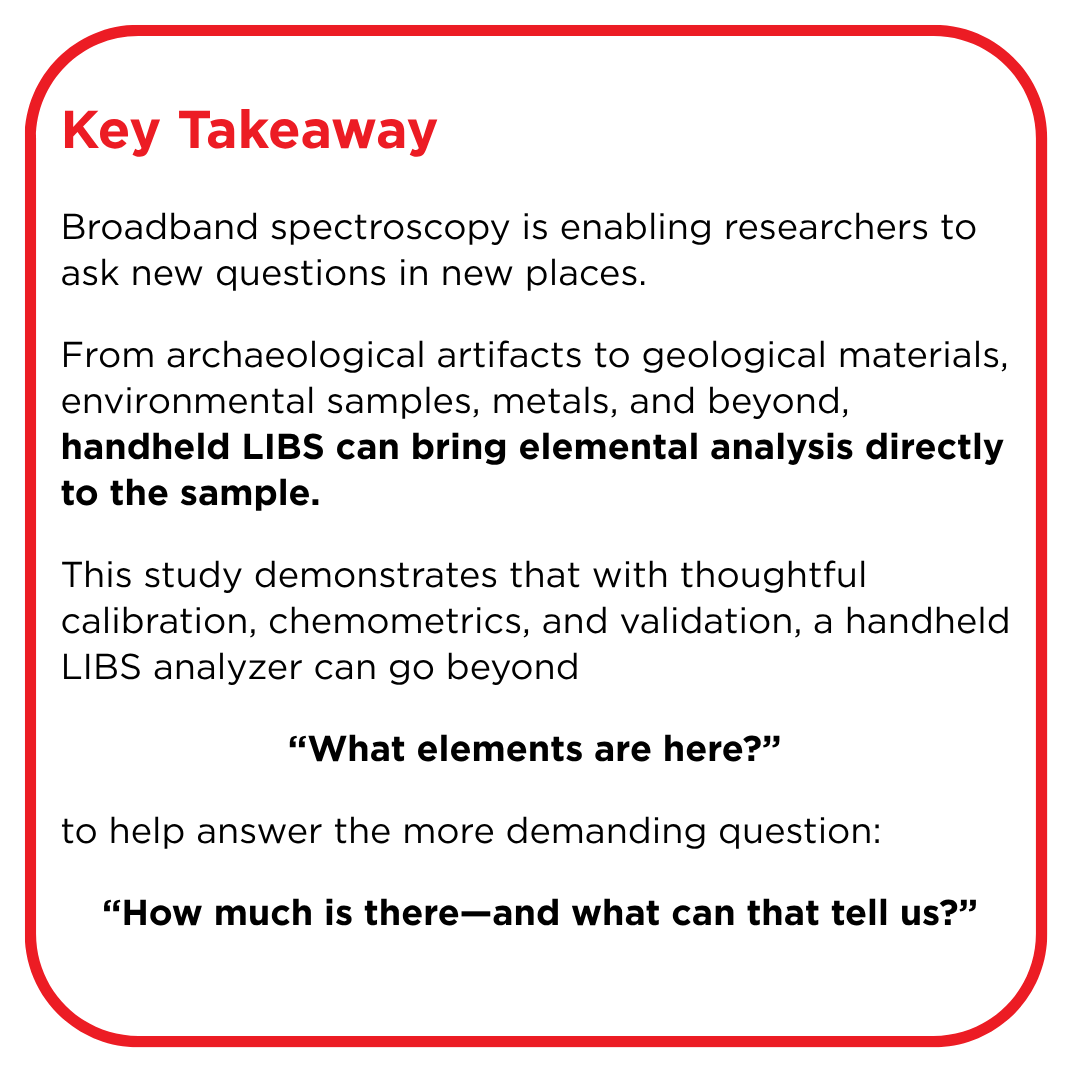
The study demonstrates the use of the Z-903 as part of a broader quantitative analytical workflow—not simply as an elemental identification tool.
The researchers successfully developed quantitative models for 19 elements, spanning major, minor, and trace components.
Several major elements demonstrated strong correlations between predicted and measured concentrations, including:
Among minor and trace elements, reported detection limits included 189 ppm for Ba, 165 ppm for Cu, 203 ppm for Mn, and 1 ppm for Rb.
When the calibration was applied to archaeological samples, the elemental compositions provided clues about the materials' origins and production.
The composition of an obsidian fragment and volcanic-rock millstone suggested similarities to volcanic materials from the nearby Aeolian Islands. The archaeological glass samples showed compositions consistent with Roman-era glass production technologies identified elsewhere in Sicily.
The significance of this research extends beyond archaeology.
It demonstrates how a handheld analytical technique can be combined with carefully selected standards and advanced chemometrics to obtain quantitative chemical information outside the traditional laboratory environment.
For archaeological research, that can mean faster analysis with less handling of valuable artifacts.
For other scientific disciplines, the same principle can apply. Broadband spectral data contains far more information than a simple list of detected elements.
With appropriate calibration and data analysis, that information can be transformed into quantitative measurements tailored to a specific material and application.
The Tindari study demonstrates an important evolution in handheld analysis: the measurement itself is only the beginning. Researchers transformed Z-903 spectral data through calibration, preprocessing, chemometrics, validation, and interpretation to extract quantitative information from archaeological materials.
Researchers will soon be able to create Machine Learning Modeling and Multi-Variate Analysis on SciAps Cloud+.
Contact us for more information.
Publication: Lando, G.; Caridi, F.; Majolino, D.; Paladini, G.; Sabatino, G.; Venuti, V.; Cardiano, P. “Chemometrics-Assisted Calibration of a Handheld LIBS Device for the Quantitative Determination of Major and Minor Elements in Artifacts from the Archaeological Park of Tindari (Italy).” Appl. Sci. 2025, 15, 6929. https://doi.org/10.3390/app15126929
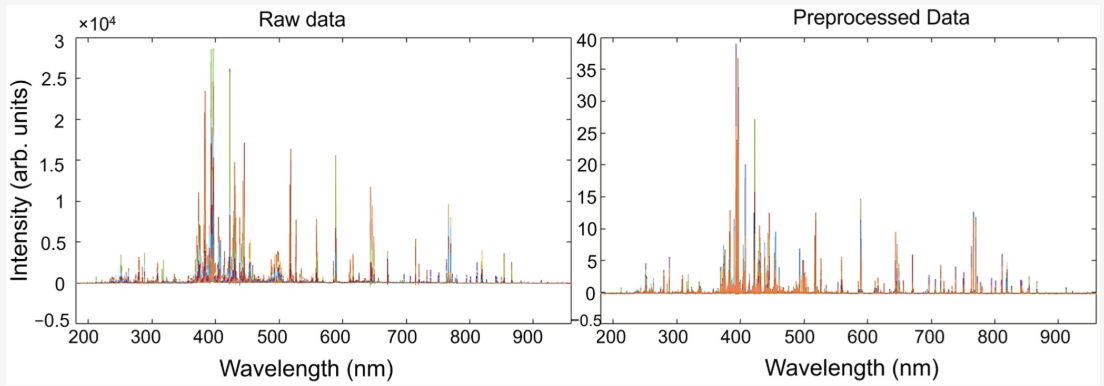
Abstract: In this study, a chemometrics-assisted calibration method was developed for the Z-903 SciAps handheld Laser-Induced Breakdown Spectroscopy (h-LIBS) device. For this purpose, seventeen silica-based standard samples with known chemical composition were collected, pelleted, and analyzed using h-LIBS. Spectral data were pre-processed using a Whittaker filter and normalized via Standard Normal Variate (SNV). The dataset was divided into calibration and validation sets using the Kennard–Stone algorithm. Partial Least Square (PLS) regression was employed for multivariate regression analysis, and a variable selection method (i.e., Variable Importance in Projection, VIP) was applied to reduce the number of predictors. Results from the PLS-VIP approach demonstrated that this device is suitable for the quantitative measurement of nineteen chemical elements, including major and minor elements, achieving significant R2 values for major elements including Na (R2 = 0.91), Mg (R2 = 0.95), and Si (R2 = 0.89). The limits of detection reached are satisfying, being, for example, 0.24%, 0.41%, 0.43%, 1.5%, and 1.7% for Na, Al,Ca, Si, and Fe, respectively, among major elements, and 189 ppm, 165 ppm, 203ppm, and 1 ppm for Ba, Cu, Mn, and Rb, respectively, among minor elements. Uncertainties in prediction of the element concentrations were compared with data from the literature, and the effect of another baseline pretreatment algorithm, airPLS (adaptive iteratively reweighted PLS), was also tested. The method was then applied to nine silica-based artifacts of different typologies sampled from the Archaeological Park of Tindari (Italy), including bricks from the theatre, archaeological glasses, and volcanic rocks.
Keywords: archaeometry; Laser-Induced Breakdown Spectroscopy (LIBS); handheld instrumentation; elemental analysis; PLS-VIP; multivariate calibration
Access to publication: https://doi.org/10.3390/app15126929
About this journal: A pioneer in scholarly, open access publishing, Multidisciplinary Digital Publishing Institute (MDPI) has supported academic communities since 1996. Based in Basel, Switzerland, MDPI has the mission to foster open scientific exchange in all forms, across all disciplines.


